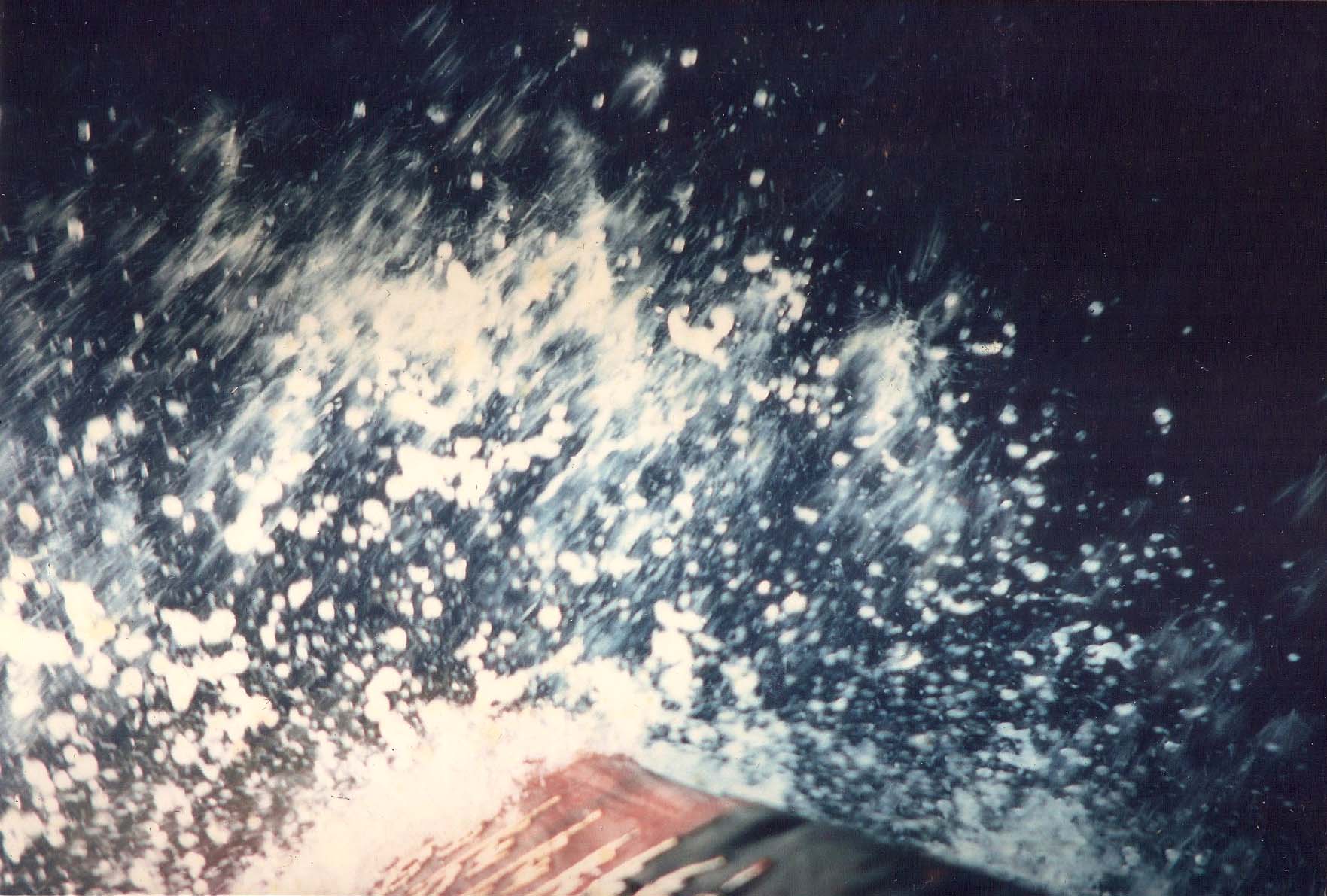
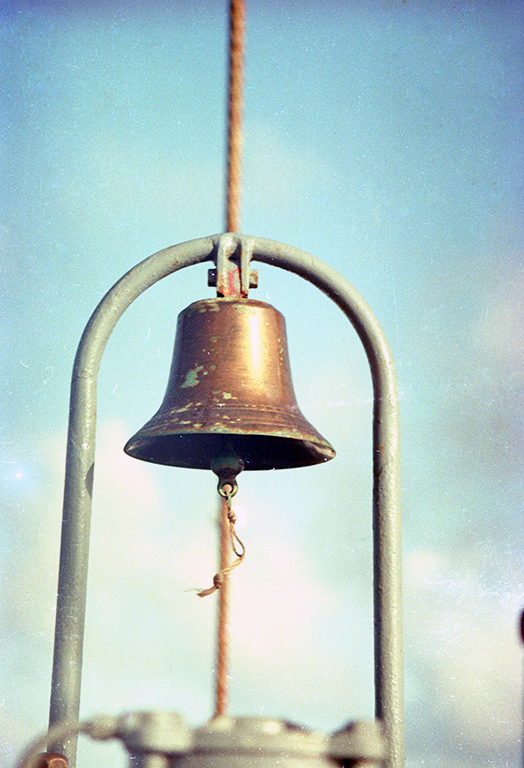
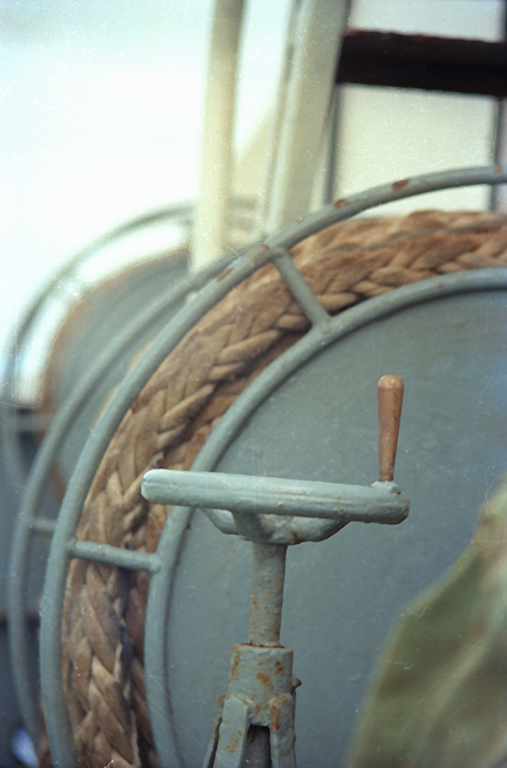
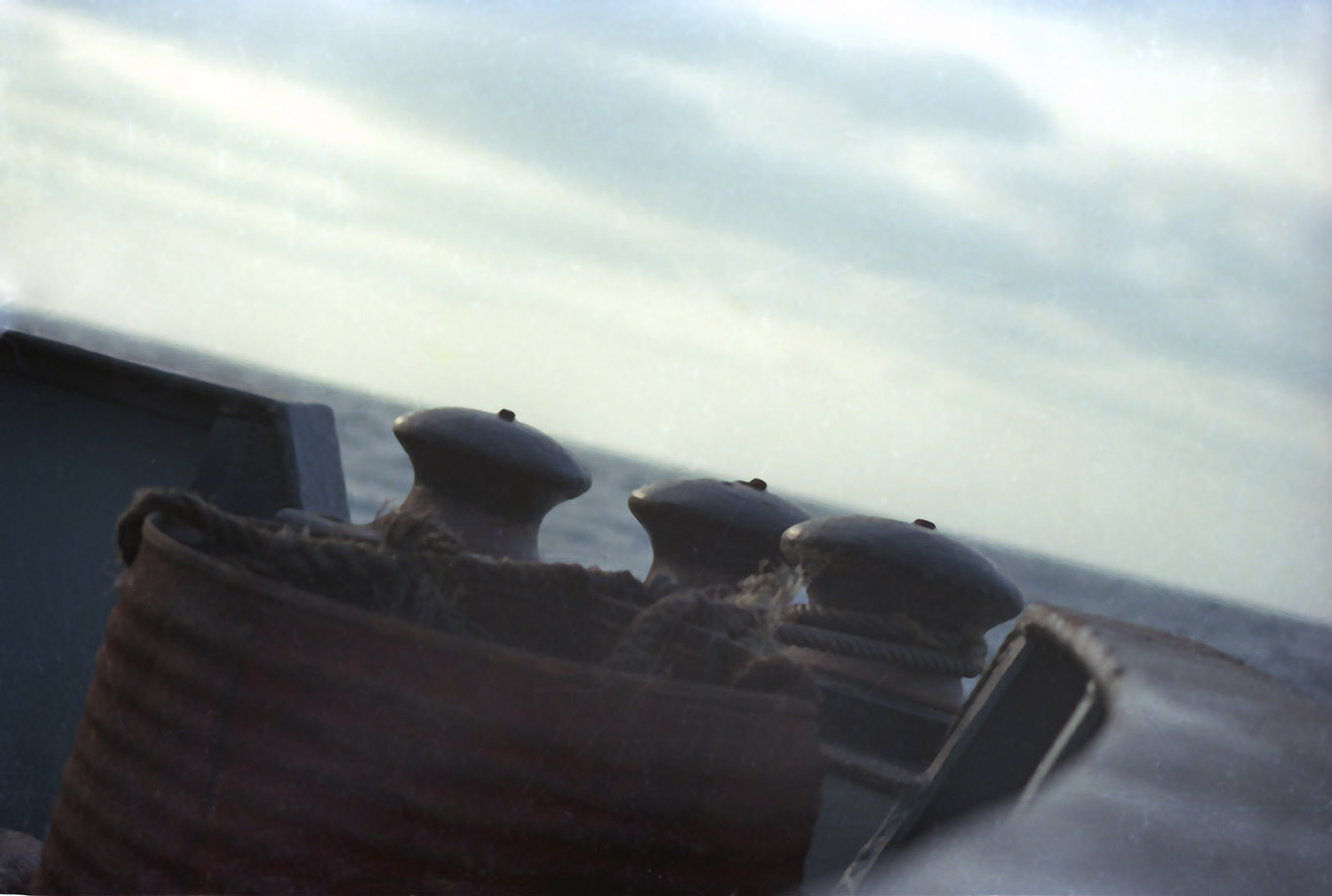
In the 1980s, while ships heading to Cape Verde were loaded with all kinds of cargo, on the return to Lisbon their holds came back nearly empty—carrying only a few containers of bananas from the island of Santiago. Southbound, the swell pushes from the stern. It’s as if one could surf in a giant made of hundreds of tons of metal—no board beneath your feet, and no waves breaking apart beneath you.
The oil-blue tone of the ocean, parted by the bow in a continuous rise and fall, reflects the depths of the sea over which we sail for days on end. Africa’s coast is nowhere in sight. Beyond the ship, the circular horizon of water all around makes me believe that the planet really is round after all.
SAILING WITH FLYING FISH
I crossed the Atlantic several times toward Cape Verde aboard cargo ships. Slowly.
The first time was in 1987, aboard the motor vessel Elsie. Later, in 1994, once again on the Elsie, and finally, in 1998, on the Morabeza.
There is always a great yearning to reach land, to reach the islands. But no less is the desire to savor the moment—to stretch it out, to prolong it as much as possible.
Like the route plotted from the bridge after departing from the Tagus, drawn on the navigation chart with ruler and square. Etched onto the paper by the pencil gliding across the same latitude and longitude, week after week, month after month, year after year.
Turning left past the Bugio lighthouse, there I go, heading south again, to Cape Verde. Always straight ahead, without hesitation, until the first stop. When I arrive, I arrive.
Northbound, the ship’s light ballast didn’t help against the trade winds, currents, and swell. The return was even slower. It felt like it was happening in slow motion.
Despite the repeated jolts—which I had grown used to, without nausea—I welcomed it all. Truly. As if I were postponing the return home for as long as I could.
Those were calm, full days shared with the crew, in long or brief conversations where the sea, the sky, the stars, dolphins—once even a whale, another time a turtle—were also companions. And still, other returns and other voyages awaited.
Among the main characters of those journeys were the flying fish.
On August 1, 1987, I wrote in the diary of my first voyage aboard the Elsie, en route from Lisbon to Praia:
“August has arrived; tonight we’ll cross the Tropic.
The sun stands at the zenith over Cape Verde… waiting for us. Today is warmer, the sea a little calmer.
If yesterday it was dolphins leaping near the ship, today it’s the flying fish, drawing lines perpendicular to the bow of the Elsie…”
“I am above the Tropic. Flying fish jump toward the ship’s lights.
Far on the horizon, another vessel crosses in the opposite direction
—just a single light lost on the edge of the dark sea.”
Two days later, more visitors came aboard:
“At first glance toward the sea, I saw a school of flying fish.
One jumped aboard, landing between me and the chief engineer’s son.
I took it to the galley, still twitching.
Mr. João (the cook) had a pile of them by the sink, fallen during the night…
now there was one more.”
THE JOURNEYS AHEAD
The Route to Cape Verde will continue here in three more parts:
Para fornecer as melhores experiências, usamos tecnologias como cookies para armazenar e/ou aceder a informações do dispositivo. Consentir com essas tecnologias nos permitirá processar dados, como comportamento de navegação ou IDs exclusivos neste site. Não consentir ou retirar o consentimento pode afetar negativamante certos recursos e funções.
Funcional
Always active
O armazenamento ou acesso técnico é estritamente necessário para o fim legítimo de permitir a utilização de um determinado serviço expressamente solicitado pelo assinante ou utilizador, ou para o fim exclusivo de efetuar a transmissão de uma comunicação numa rede de comunicações eletrónicas.
Preferências
O armazenamento ou acesso técnico é necessário para o propósito legítimo de armazenamento de preferências não solicitadas pelo assinante ou utilizador.
Estatísticas
O armazenamento técnico ou acesso que é usado exclusivamente para fins estatísticos.O armazenamento técnico ou acesso que é usado exclusivamente para fins estatísticos anónimos. Sem uma intimação, conformidade voluntária por parte do seu Fornecedor de Serviços de Internet ou registos adicionais de terceiros, as informações armazenadas ou recuperadas apenas para esse fim geralmente não podem ser usadas para identificá-lo.
Marketing
O armazenamento ou acesso técnico é necessário para criar perfis de utilizador para enviar publicidade ou para rastrear o utilizador num site ou em vários sites para fins de marketing semelhantes.