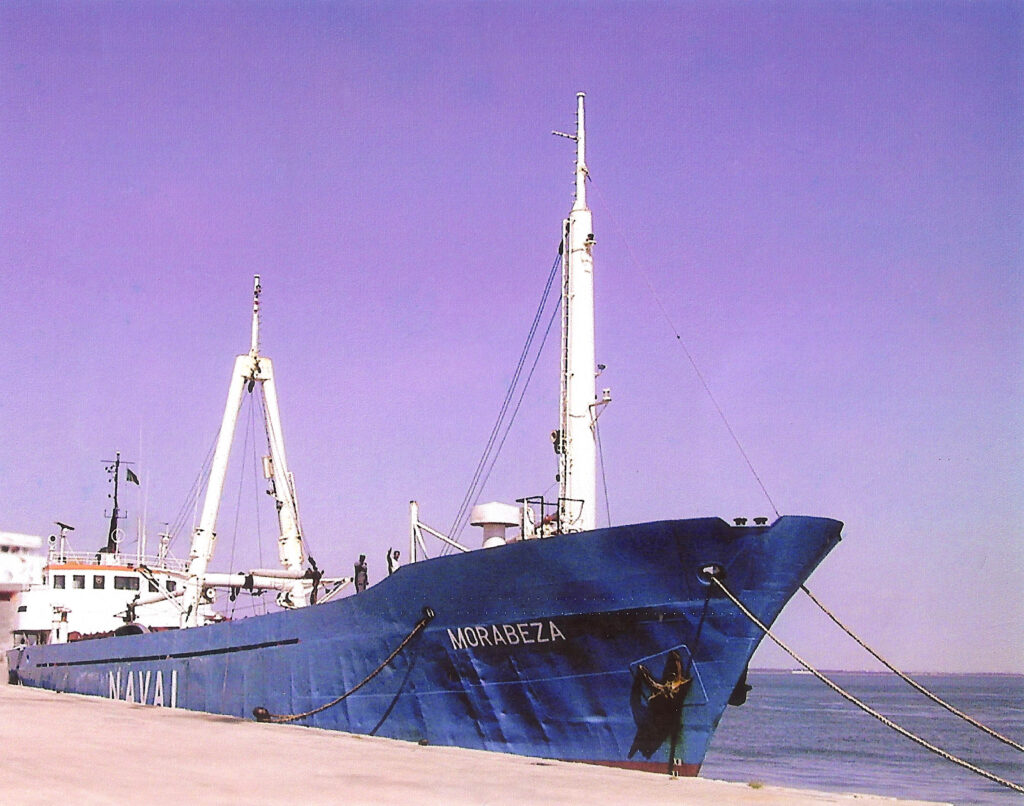
THE GROUND SLIPPING FROM UNDER OUR FEET
After several consecutive days at sea, once ashore, the ground no longer feels the same as before setting sail. We become so accustomed to the sway of the ship that, upon reaching land, it seems to slip from under our feet.
This is a metaphor for deep-sea sailing. It gets under your skin. First through the enchantment of the open ocean, then through the adaptation to life off the ship—with unsteady feet searching for stability. Yet, there remains a constant desire to set new courses on new maritime journeys.
BETWEEN THE INDIAN OCEAN AND THE ATLANTIC
It was the beginning of 1998. I was once again setting sail for Cape Verde with a close friend whose family hails from the island of Fogo. The island of the volcano was once more the final destination of the journey. Paulo Costa, who had previously worked on fishing campaigns in Namibia and also in cod fishing, was returning—like me, for a few days—to the life of a seafarer.

Our holiday came just a few months before the conclusion of the Indian Ocean Cultures project, promoted and produced by the Discoveries Commission to mark the 500th anniversary of Vasco da Gama’s voyage to India. With a vast program—including exhibitions, book and CD publications, concerts, conferences, documentaries, and documentary series—the initiative culminated in an exhibition of the same name, inaugurated at the National Museum of Ancient Art in June of that year.

Two oceans loomed on the near horizon. Both on land and offshore. The Atlantic will always feel like home. I was born and raised on the Saloia coast; I lived in Cape Verde as a child, and the sea was always present while I was there. Starting in 1996, when I worked with the Discoveries Commission, I came to know the Indian Ocean and the East African coast—particularly Mozambique, Tanzania, Zanzibar, and Kenya. I then discovered other worlds—equally fascinating and entirely different from those I had known on this continent.

Unlike the Indian Ocean, where I constantly questioned and confronted what I encountered, returning to Cape Verde by ship, on the verge of the commemorative events to come, felt like coming home. Everything was familiar. Speaking Creole certainly helped that sense of comfort. It was like dropping anchor at my doorstep. Umbilical.
ABOARD THE MORABEZA

This time, the journey wasn’t aboard the Elsie, but a different ship: the Morabeza. In Creole, Morabeza means kind, gentle, welcoming. Aboard this fragile-looking, old-fashioned vessel, these qualities were more than just a name—they became reality. We departed Lisbon toward the island of Santo Antão, then on to Mindelo on São Vicente, and finally to Praia on Santiago Island. Day and night confirmed that those very attributes—gentleness and hospitality—were what we would indeed find and share along the way.

This ship was even smaller than the Elsie. On my last journey aboard the Elsie, as we entered the port of Viana do Castelo—where the Morabeza had just arrived—I clearly remember the joking and teasing aimed at the other crew. Both ships had come from Cape Verde. The Elsie was headed for Lisbon, while the Morabeza was bound for Viana do Castelo. The Elsie had passed it in the Canary Islands en route to the Tagus, where it stopped to load. It then resumed its voyage north. Since the Morabeza had stayed anchored in Tenerife to avoid bad weather, both ships ended up arriving at nearly the same time.
Little did I know that, a few years later, I would have the chance to cross the seas aboard this “charming” ship as well.
I never rushed these trips. The slower, the better. Even though that year—due to the circumstances I mentioned—we couldn’t return to Lisbon by ship, each day aboard was lived with joy and a desire to fully enjoy another chance to cross the Atlantic toward the tropics. And having my friend Paulo along only enhanced that immense pleasure—traveling together in this way and being able to share what was, after all, also our land: Cape Verde.
One of the greatest rewards of spending days at sea on a cargo ship is the human connection formed with the crew. From the bridge to the engine room, the kitchen to the deck where there are sometimes tasks to be done.
The ship becomes a shared home. You move freely through the spaces, getting to know those who share this experience with you, learning from one another.
In this open-sky prison, creativity knows no limits. The stairs to the cabins can easily become an improvised gym, just to keep in shape. A sailor tosses a rope with a rag tied to a hook overboard, hoping that the ship’s motion might attract a large fish—even though there’s no bait! In the kitchen, we talk for hours, sharing a routine that becomes more familiar by the day, while sipping a beer, preparing a meal, or just enjoying a snack.
During the journey, in addition to filming and taking photographs, I also recorded some soundscapes aboard. Using a MiniDisc, I captured the sound of the sea from the bow, and later the sound on deck—including the rumble of the ship’s funnel. If I close my eyes, it’s a sound that rocks me to sleep. It feels like it was just yesterday.
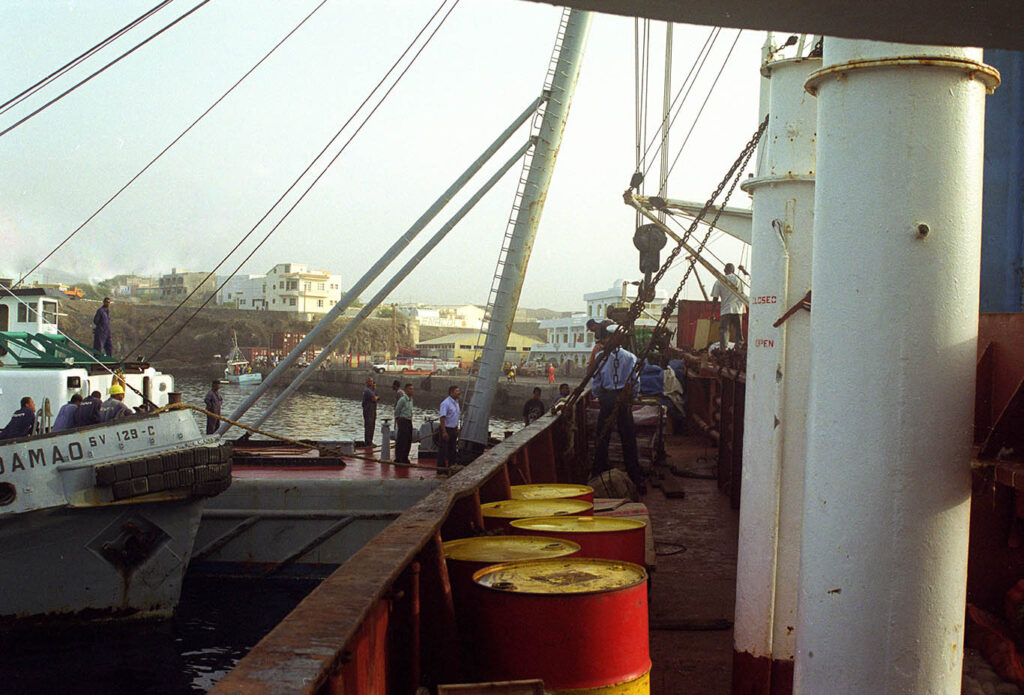
Our first stop in Cape Verde was Porto Novo, on the island of Santo Antão. We stayed there only a few hours to unload a crane. Then we quickly set off across the channel to the island of São Vicente.


A few years later, I found the Morabeza again—this time docked in Lisbon. I visited the crew. The ship was now painted blue, but it still held all the charm of a cargo vessel seasoned with life—just like the sea wolves who sail aboard her.