This video is the result of a documentary recording of the work involved in transferring a collection of sculptures from a private estate in the Serra de São Mamede, in Portalegre, to the facilities of the Robinson Foundation, which had acquired the collection with the aim of preserving it and promoting its conservation, study, and dissemination.
I was part of a team coordinated by António Camões Gouveia, which included, notably, Laura Romão, who accompanied me throughout all the filming and was responsible for the inventory and supervision of the transportation process. Also collaborating in this project was archaeologist Rui Lourenço, who carried out the 3D documentation of the more than 6,000 pieces in the collection.

THE PART WITHOUT THE WHOLE: NOTES OF THE EXPERIENCE OF VIDEO RECORDING THE SEQUEIRA COLLECTION

“When the Robinson Foundation invited me to record the Sequeira Collection on video, I was given two distinct guiding principles:
Firstly, the video should emphasize its documentary value—that is, it should aim to capture as many elements as possible to allow, in the future, a visual reconstruction of the changes that occurred during the different stages of the collection’s relocation.

Secondly, I was encouraged to bring in my own perspective. Rather than merely documenting reference shots and recording the people involved in the process, I was to reflect my own personal relationship with the pieces and the collection as a whole—allowing myself to be influenced by the emotional and subjective impact that the collection evoked.
The process resulted in nearly 14 hours of footage. The video presented here was part of the installation of the collection at the Church of São Francisco in 2011. (…)

Each sculpture claimed its own relationship to the space, yet all seemed to represent the same recurring image taken to the point of exhaustion: the mark of the Cross and of Christ—sometimes with open arms, sometimes fragmented, with only disjointed limbs remaining, suspended in unsettling ways. It felt as if, right before my eyes, divinity gave way to a chaos beyond the known limits of apocalyptic representation.

When I was finally able to move freely—no longer physically blocked by the clusters of sculptures that had been gradually removed—I could begin to explore the works at their own scale. In many cases, this meant experiencing them at floor level, where most of them were placed.

At this stage, every time I paused to consider how to proceed with the work, new possibilities felt increasingly enticing. Curiously, it was only toward the end that I felt most confident and in control of the shooting process. Perhaps, with the urgency of the recording behind me, I could finally enjoy the work more deeply—thanks to the empathy I had developed with the sculptures.
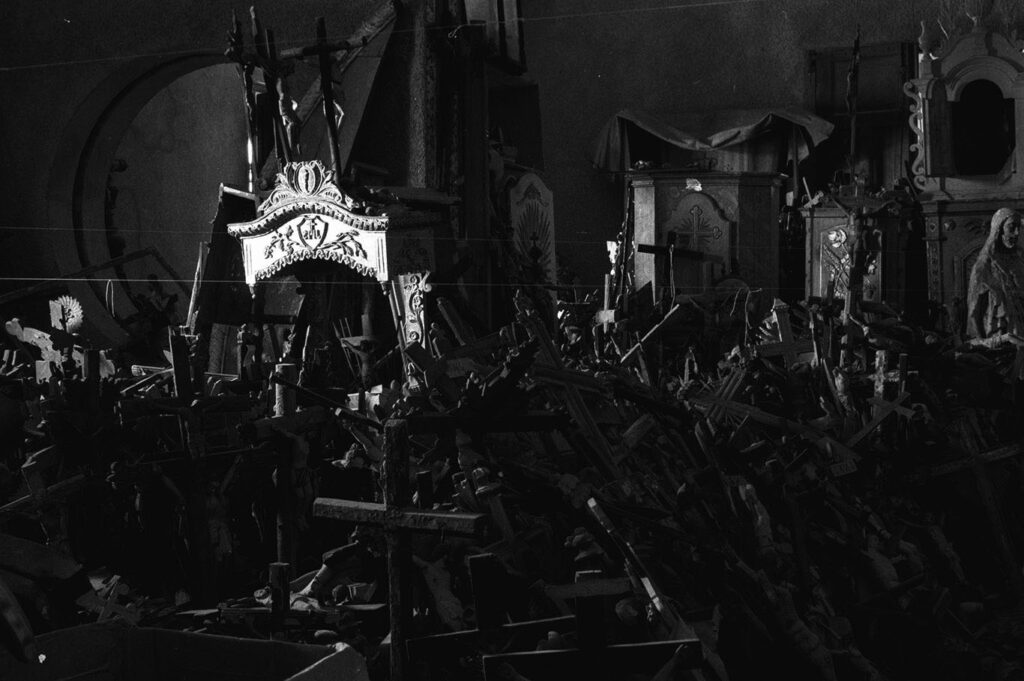
That empathy came largely from the fact that the pieces were slowly revealed to me from a whole I had never fully known or understood—acquiring, over time, a multiplicity of meanings within that particular space.
It was as if I were following a kind of diachronic thread, now reversing or grafting time in the opposite direction: one by one, the sculptures were removed from where someone had once left them—and left them again for years—until, within a few short months, they were all taken away, leaving the space completely empty.”

in MURTEIRA, Jorge “A parte sem todo. Apontamentos da experiência do registo em vídeo da Colecção Sequeira” Publicações da Fundação Robinson 9, 2008, pg 6-9.
You can access the Robinson Foundation’s publication here: