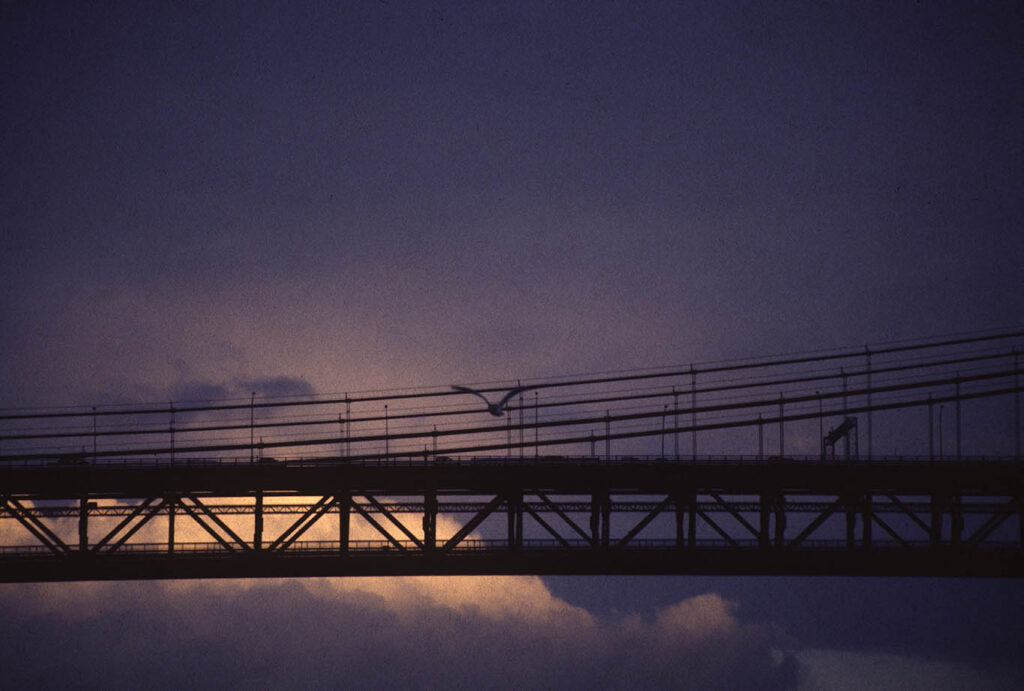
We are just a few hundred meters from the river and the bridge over the Tagus. Night falls in Lisbon.
The same distance separates the setting of this monologue from the Parliament and the official residence of the Prime Minister, who, the following year, would become President of the European Commission.
A WAR OF LIES AND VANITY
The world seemed shaken on that March 22nd, 2003.
Two days earlier, American troops had entered Iraq to overthrow Saddam Hussein’s regime. The invasion was justified by claims that they possessed weapons of mass destruction.
Two years later, a CIA report confirmed that, in fact, it was not true. Those weapons never existed.
In the afternoon of March 16th that same year, history recorded the Lajes Summit and the image of Durão Barroso in the Azores receiving Bush, Blair, and Aznar, when a war—unsanctioned by the UN—was decided.
Later, when the lie was already known, the Spanish Prime Minister would refer to that photo as “his best picture.”

DEMOCRACY IS FOR EVERYONE !
The protagonist of this monologue fought in Angola. The media pressure at the time was fixated on the Iraq invasion, its coverage blaring from the radio in his car—and it certainly contributed to what I witnessed.
Just a few meters from the residence of a former Prime Minister who would later become President of the Republic, a pensionless retiree, deeply disillusioned, shouts his anguish in despair.
His target seems obvious. His voice echoes through the entire street. For anyone willing to listen:
– I’m not afraid of anyone!
Inside his car, he denounces the injustices he claims to suffer: despite his repeated appeals, he receives no social support and lives in extreme hardship. No one seems to be listening.
I have no pension at all, I asked for aid. I’ve got war trauma, no one ever helped me. Not until today! I eat raw meat, bugs — I don’t even have documents!

The monologue lasts more than half an hour. At first, he lists the PS, PSD, and CDS politicians he contacted, all of whom failed to solve his problem. With every complaint or threat, he swings open the car door to make himself heard, then slams it shut, loudly expressing his indignation.
It’s not even 10 a.m. yet — noise is still allowed. I can speak. The PIDE is over. That was back then.”
“Democracy is for everyone!
All he has left, he says, is to “cause a big scandal on TV,” and warns that if nothing is done to help him, he’ll go on Fátima Lopes’ show, or SIC 10 horas.
He talks about the commentators and politicians who may understand politics but know nothing about war. Some of them are still active today:
“Paulo Portas knows about politics. But he knows nothing about war.”
“Mr. Durão Barroso, he knows politics — but war? He knows nothing.”
“Nuno Rogeiro, he knows about politics. War? Maybe a bit…”
His agitated voice slowly loses intensity, shifting to a calmer, almost confessional tone:
“I haven’t slept in three nights, since the war began.”
Until finally, he steps out of the car and stops shouting. As if speaking only to himself, he walks down the street with the help of crutches. He moves slowly, swallowed by the roar of a plane taking off from Portela Airport.
It was a bitter, anguished monologue.
Without Cavaco.