People want “everything just for me”
and forget the person beside them.
Because I want a lot for myself.
I want to have it all.
And the one next to me, they forget.
If they have problems, that’s their problem.
Leave them be…
— Teodoro Tavares

The documentary We Are Here portrays the work of Associação Limiar – Association for Cooperation and Development – with people who benefit from its support and live in the Rego neighborhood, in Lisbon.
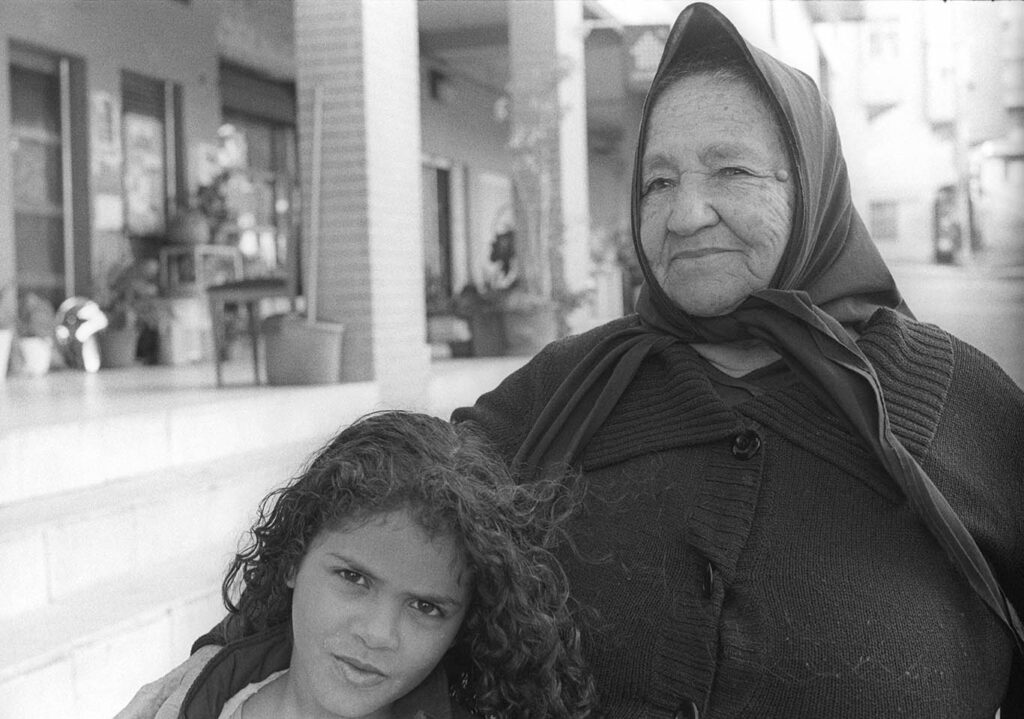
It is guided by the testimonies of residents about their lives and the importance of the Association’s presence in their daily routines.
The film was made as part of the Move4Life project, funded by the Calouste Gulbenkian Foundation. Created with the aim of developing a proximity-based intervention model, the project considered the profiling and social diagnosis of the residents targeted by the intervention, in order to find alternative responses for an elderly and/or dependent population that has been poorly served by existing social support mechanisms.

ANOTHER CITY
Barely five minutes pass before the thunderous roar of another plane’s engines can be heard. Between the buildings, for a few seconds, you see another aircraft flying overhead—either just taking off or a few seconds from landing at Portela Airport. The constant noise from above blends with the sound of the CP and Fertagus trains running right nearby.
Located near the University of Lisbon and Avenidas Novas, close to Campo Pequeno, this is a central area of the capital. But getting there is not easy, as it is literally cut off to the south by the circular railway line. Those who come through or pass by Entrecampos train station—from the south, north, or west—are not far from these buildings.

Previously, the only separation was a few of the last remaining vegetable gardens by the tracks. The last cultivated patch gave way to a nursing home sponsored by a major national bank. More recently, a large mirrored office building was erected nearby, overlooking the train station—just a few hundred meters from where the film’s protagonists live.
Here, the buildings are municipal social housing, built in the late 1990s, before most of the modern buildings that now surround them.

Although housing itself is not the main issue here, these buildings seem to have been forgotten over the decades, receiving little to no maintenance. Forgotten, too, seem to be the residents—especially those who rely on Limiar’s social support.
REBUILDING SOCIAL BONDS

The Association’s intervention takes place on the ground, day by day, through social work, mobility support for the elderly, partnerships, and many other efforts documented in the film.
For Orlando Garcia, from Associação Limiar, it’s about:
embracing simple, direct, immediate solutions that are not transcendent at all, let’s be honest:
people have trouble moving around, walking, getting from place to place,
let’s tackle that problem, let’s start there.
And from there we create a process of ongoing, daily intervention.
That is, let’s establish a routine.
Let’s install a new routine and, through that new routine,
let’s rebuild social bonds.

It’s not only because of the worsening social conditions of recent years—but also for that reason—that Limiar’s work makes such a difference for those who benefit from it. The close support and care provided in the Rego neighborhood is a remarkable example of practical, effective social solidarity.